
Underfloor Heating with a Heat Pump: Manifold, Pipe Spacing & Flow Temperature Explained
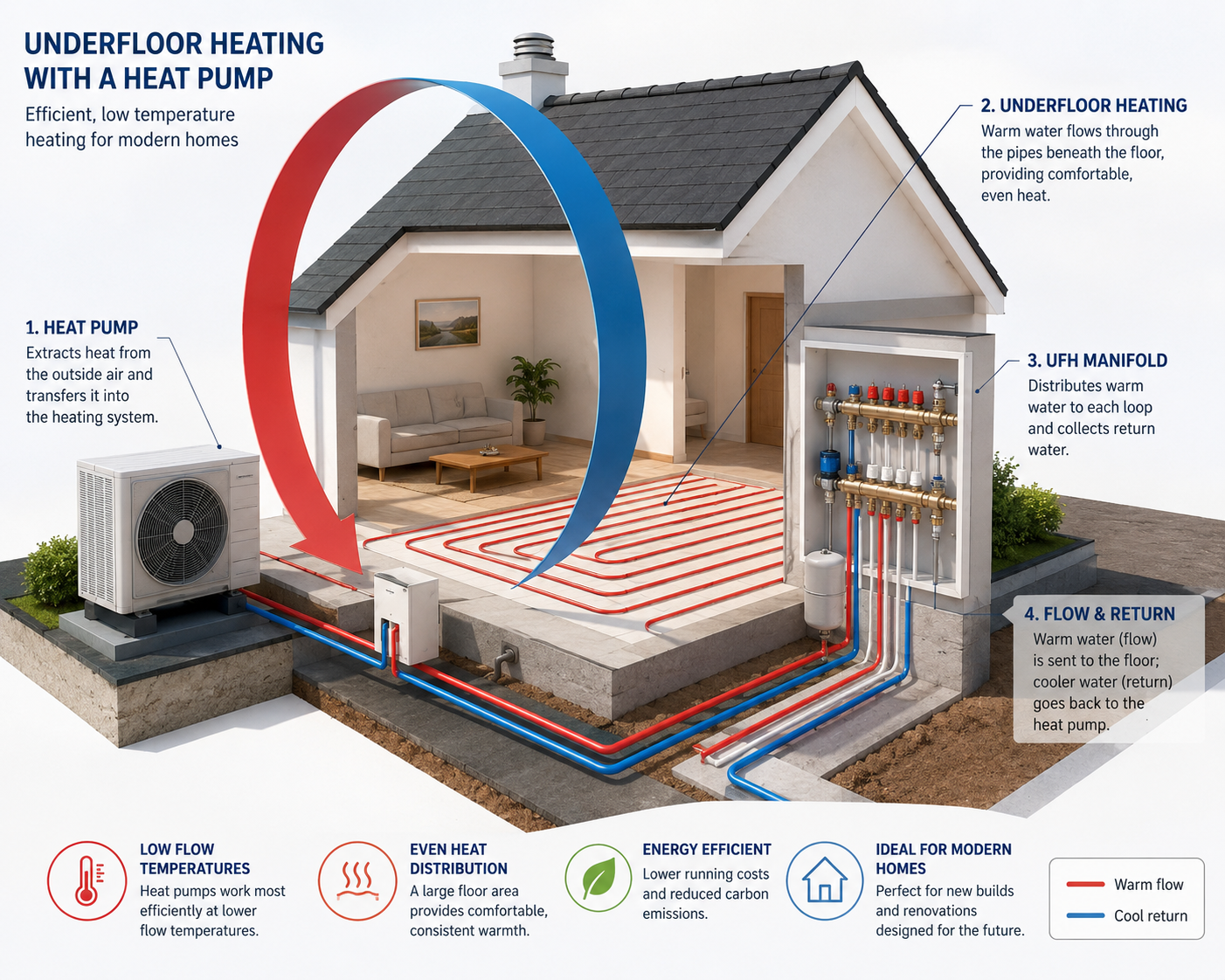
Underfloor Heating with a Heat Pump: Manifold, Pipe Spacing & Flow Temperature Explained
Combining underfloor heating with a heat pump can create an efficient, comfortable low-temperature heating system for UK homes. Heat pumps generally work most efficiently when they can supply heating water at relatively low temperatures, while water underfloor heating uses a large floor surface to distribute heat throughout a room.
This makes the two technologies particularly well suited to each other.
However, simply connecting a heat pump to an existing underfloor heating system does not guarantee good performance. The UFH pipe spacing, manifold configuration, flow rates, flow temperature, floor construction and heat loss of the property all need to be considered as part of the overall system design.
In this guide, we explain how heat pumps work with water underfloor heating, what flow temperatures may be required, how pipe spacing affects performance, how to select an underfloor heating manifold and whether a separate pump and mixing valve are necessary.
Why Does Underfloor Heating Work Well with a Heat Pump?
Heat pumps are different from conventional boilers.
Instead of generating heat through combustion, a heat pump transfers thermal energy from the outside air, ground or water into the heating system.
One of the key factors affecting heat pump efficiency is the temperature of the water it needs to produce.
In general, the lower the required heating flow temperature, the easier it is for a heat pump to operate efficiently.
This is where underfloor heating has an advantage.
Traditional radiators provide heat from a relatively small surface area. Underfloor heating effectively turns a large proportion of the floor into a heat emitter.
Because the heat-emitting area is much larger, the UFH system can potentially provide the required room heat output using lower water temperatures.
This makes water underfloor heating with a heat pump an attractive combination for new builds, renovations and energy-efficient properties.
What Flow Temperature Does Underfloor Heating Need with a Heat Pump?
There is no single correct underfloor heating flow temperature for every property.
The required temperature depends on several factors, including:
- Room heat loss
- Heated floor area
- Pipe spacing
- Floor construction
- Floor covering
- Insulation
- Required room temperature
- Outdoor design temperature
- Required water flow rate
Many heat pump systems operate at considerably lower heating-water temperatures than traditional boiler systems.
For example, Energy Saving Trust states that the majority of heat pumps generate heating flow temperatures at around 40–45°C, although the actual design temperature varies between systems.
An appropriately designed UFH system may be capable of operating below this, particularly in a well-insulated property with suitable pipe spacing and sufficient heated floor area.
The objective should not be to choose an arbitrary temperature such as 35°C or 40°C before designing the system.
Instead, the design should establish the lowest practical flow temperature capable of meeting the calculated heat loss of the property.
Why Is a Lower Flow Temperature Important?
Heat pump efficiency is influenced by the difference between the source temperature and the temperature the heat pump needs to produce.
Requiring hotter water generally means the heat pump has to work harder.
Therefore, reducing the required heating flow temperature can improve system efficiency.
This is one reason why correct UFH design is particularly important when installing a heat pump.
Heat Loss Should Come Before UFH Design
Before selecting the manifold, pipe spacing or flow temperature, the property should have an appropriate room-by-room heat loss calculation.
Heat loss tells you how much heat each room requires under the specified design conditions.
For example, two rooms with the same floor area may require very different amounts of heat if one has:
- Large external walls
- Large windows
- Poorer insulation
- More exposed surfaces
while the other is an internal, well-insulated room.
This information then helps determine whether the available heated floor area can provide the required output at the proposed water temperature.
For heat pump installations, this is especially important because simply increasing the water temperature to compensate for an inadequate emitter design can reduce efficiency.
Underfloor Heating Pipe Spacing for a Heat Pump
Pipe spacing is one of the most important elements when designing underfloor heating for a heat pump.
Common residential UFH pipe spacings include:
- 100mm centres
- 150mm centres
- 200mm centres
The correct spacing should be determined from the required heat output rather than applying the same spacing throughout every project.
100mm Pipe Spacing
Installing pipe at 100mm centres provides more pipe within a given floor area.
Closer spacing can help:
- Increase available floor heat output
- Provide more even floor temperatures
- Reduce the water temperature required for a given output
- Support low-temperature heat pump operation
However, closer spacing requires more pipe and may result in more heating loops.
For high heat-loss rooms or systems designed around particularly low flow temperatures, closer spacing may therefore be appropriate.
150mm Pipe Spacing
150mm spacing is commonly used in residential water underfloor heating systems.
It can provide a useful balance between:
- Heat output
- Pipe quantity
- Loop length
- Number of manifold circuits
- Installation cost
Whether 150mm is suitable for a heat pump project depends on the room heat requirements and proposed flow temperature.
It should not automatically be considered the correct spacing for every installation.
200mm Pipe Spacing
200mm spacing requires less pipe but also increases the distance between the heating circuits.
Depending on the floor construction and operating temperatures, wider spacing can reduce the available heat output and create greater temperature variation across the floor surface.
It may be perfectly adequate in a low-heat-loss property, but it should be confirmed by the design.
For a heat pump system where achieving the required output at a low flow temperature is a priority, using wider spacing simply to reduce the amount of pipe can be a false economy.
Is 100mm or 150mm Spacing Better for a Heat Pump?
Neither is universally better.
The correct choice depends on the heat-loss calculation and the output available from the floor at the proposed operating temperature.
A good UFH design should determine the spacing room by room, rather than selecting one value for the entire property without considering heating demand.
Underfloor heating pipe spacing
What Underfloor Heating Pipe Should Be Used with a Heat Pump?
16mm underfloor heating pipe is widely used in UK residential water UFH systems and can be used in heat pump installations when correctly designed.
Common pipe constructions include:
- PERT
- PEX
- PERT-AL-PERT / MLCP
- Oxygen-barrier UFH pipe
The choice of pipe should take account of its temperature and pressure ratings, oxygen barrier, installation method and hydraulic characteristics.
For a heat pump system, pipe diameter and circuit lengths are particularly important because adequate water flow must be maintained through the system.
How Long Should UFH Pipe Loops Be?
Excessively long circuits increase hydraulic resistance and can make it more difficult to achieve the required flow.
For 16mm underfloor heating pipe, around 100 metres per circuit is commonly used as a practical maximum guideline, although the final permitted loop length should always be based on the particular pipe and hydraulic design.
For example, if a large open-plan area requires approximately 180 metres of pipe, dividing it into two circuits of approximately 90 metres will generally be more appropriate than creating one 180-metre circuit.
Keeping circuit lengths reasonably balanced also helps when commissioning and balancing the manifold.
Maximum 16mm UFH pipe loop length.
Choosing an Underfloor Heating Manifold for a Heat Pump
The underfloor heating manifold is the distribution centre of the UFH system.
It divides the incoming water between the individual pipe circuits and allows their flow rates to be adjusted.
A typical UFH manifold may include:
- Flow meters
- Return valves
- Air vents
- Fill and drain points
- Isolation valves
- Connections for thermal actuators
Manifolds are available in various sizes, commonly ranging from small 1- or 2-port arrangements to larger 10- or 12-port systems.
How Many Manifold Ports Do You Need?
The manifold should be sized according to the number of pipe circuits, not simply the number of rooms.
For example:
A small bedroom might require one circuit.
A large living area could require two or three.
An open-plan kitchen/dining/living area might require several circuits.
If the complete UFH design contains eight pipe circuits, an 8-port manifold would normally be required.
This is why the pipe layout should ideally be prepared before purchasing the manifold.
Do You Need a Pump on an UFH Manifold with a Heat Pump?
This is one of the most important questions when combining underfloor heating and a heat pump.
With conventional boiler systems, UFH manifolds are commonly supplied with a dedicated circulation pump and thermostatic mixing valve.
However, a heat pump installation should not automatically be treated in the same way.
If the heat pump is already producing water at the correct temperature for the underfloor heating system, there may be no requirement to mix that water down to a lower temperature.
Similarly, whether an additional manifold pump is required depends on the hydraulic design and the capabilities of the heat pump’s circulation arrangement.
Adding unnecessary pumps or mixing arrangements can increase complexity and potentially interfere with the intended flow characteristics of the system.
The correct arrangement should therefore be determined by the heat pump and UFH system designer.
Does a Heat Pump Need an Underfloor Heating Mixing Valve?
Not necessarily.
A thermostatic mixing valve is typically used where the primary water temperature is higher than the temperature required by the UFH circuits.
For example, this can be useful where a boiler supplies relatively high-temperature water to radiators while the UFH requires a lower temperature.
With a heat pump, however, the heating circuit may already be operating at a low temperature suitable for UFH.
In that situation, mixing already-low-temperature water with cooler return water may be unnecessary.
This is why a heat-pump UFH system should not automatically be specified using the same manifold pump/mixing set that would be used on a conventional high-temperature boiler installation.
underfloor heating manifold and pump kits
Flow Rates Are Just as Important as Flow Temperature
It is easy to concentrate entirely on temperature when discussing heat pumps.
However, water flow rate is equally important.
The amount of heat transferred by a water-based heating circuit depends on:
- Flow rate
- Difference between flow and return temperatures
- Heat-transfer characteristics of the circulating fluid
Heat pump systems can require relatively high flow rates compared with traditional high-temperature boiler systems because they commonly operate with a smaller temperature difference between flow and return.
The manifold, pipe circuits, pumps and primary pipework therefore need to be capable of providing the required flow without excessive resistance.
This is another reason why simply connecting a heat pump to an existing UFH manifold without checking the hydraulic design is not always appropriate.
Balancing an Underfloor Heating Manifold with a Heat Pump
Once the system has been installed, each UFH circuit needs to receive an appropriate flow rate.
This is achieved through manifold balancing.
Not every circuit requires exactly the same flow.
A larger room with a greater heat requirement may need a different flow rate from a small bedroom.
Similarly, circuits of different lengths create different hydraulic resistance.
The manifold flow meters allow the installer to adjust the individual circuits according to the system design.
Correct balancing helps:
- Deliver the required heat to each room
- Maintain suitable flow through the system
- Reduce the risk of rooms heating unevenly
- Support efficient heat pump operation
Heat Pump Weather Compensation and Underfloor Heating
Modern heat pumps commonly use weather compensation.
Instead of supplying the same heating-water temperature regardless of conditions outside, weather compensation adjusts the flow temperature according to outdoor temperature.
When the weather becomes colder, the required flow temperature can increase.
When outdoor temperatures rise and the property requires less heat, the flow temperature can decrease.
This is particularly useful with underfloor heating because UFH systems are well suited to steady, low-temperature operation.
Correctly configured weather compensation can help the heat pump operate for longer periods at lower temperatures instead of repeatedly switching on and off.
The correct weather-compensation curve must be established for the particular property and heating system.
Underfloor Heating Controls for Heat Pumps
A heat pump and UFH system need controls that work together rather than against each other.
A conventional multi-zone UFH arrangement might include:
- Room thermostats
- Wiring centre
- Thermal actuators
- Manifold
- Heat-source demand connection
When a room requires heat, the thermostat communicates with the wiring centre, which opens the relevant actuator.
However, excessive zoning or frequently closing most of the UFH circuits can potentially create flow and minimum-water-volume issues for some heat pumps.
Heat pump manufacturers specify minimum system flow and, in many cases, minimum available system water volume.
The complete control strategy should therefore be considered during the heat pump design.
underfloor heating thermostats
Smart Thermostats with Heat Pump Underfloor Heating
Smart thermostats can provide useful functionality such as:
- App control
- Heating schedules
- Individual room temperature settings
- Holiday modes
- Remote control
- Multi-zone management
However, compatibility should be checked carefully.
Heat pumps are designed to operate differently from traditional boilers, and aggressive on/off control is not necessarily the most efficient strategy.
Where possible, the room controls should complement the heat pump’s own weather-compensation and modulation strategy.
smart thermostat for underfloor heating
Floor Construction Matters
The performance of heat pump underfloor heating is influenced heavily by the floor construction.
Screeded Floors
Pipe installed within screed provides a large thermal mass.
Once heated, the floor can release heat steadily over a long period.
This can work particularly well with heat pumps, which generally favour steady operation rather than rapid heating and cooling cycles.
Suitable installation systems can include:
- Castellated panels
- Pipe clips
- Fixing rails
- Mesh systems
castellated underfloor heating panels
Suspended Timber Floors
UFH can also be installed between joists.
Aluminium spreader plates are commonly used to distribute heat from the pipe across the floor.
Good insulation beneath the plates is important to reduce unwanted downward heat loss.
aluminium spreader plate
Grooved UFH Boards
Grooved insulation and overlay boards provide another method of positioning UFH pipe.
Boards incorporating aluminium foil or heat-spreading layers can help transfer heat across the floor surface.
These systems can be particularly useful for renovation projects or where traditional screed construction is unsuitable.
grooved underfloor heating boards
Insulation Is Critical with Heat Pump UFH
A low-temperature heating system benefits greatly from good building insulation.
If the property loses heat quickly through its walls, roof, windows or floor, the heating system needs to provide more energy to maintain the required indoor temperature.
Good insulation beneath the UFH system also helps reduce unwanted downward heat transfer.
For heat pump projects, the building fabric and heating system should therefore be considered together.
Improving insulation can potentially:
- Reduce room heat loss
- Reduce required UFH output
- Allow lower flow temperatures
- Improve comfort
- Reduce heating demand
Common Mistakes When Installing Underfloor Heating with a Heat Pump
1. Choosing Pipe Spacing Without a Heat-Loss Calculation
Using 200mm spacing simply because it requires less pipe can be a mistake if the floor cannot provide sufficient heat output at the intended heat pump flow temperature.
2. Using a Boiler-Style Pump and Mixing Set Automatically
A mixing valve is useful when high-temperature primary water needs to be reduced for UFH.
If the heat pump is already supplying appropriately low-temperature water, unnecessary mixing may not be beneficial.
3. Making UFH Loops Too Long
Long circuits increase hydraulic resistance and can make achieving the required flow more difficult.
4. Ignoring Required Flow Rates
A low-temperature system still needs to transfer enough energy to heat the property.
Correct flow through the heat pump, primary pipework, manifold and UFH circuits is essential.
5. Poor Manifold Balancing
Incorrect flow rates can result in some rooms receiving too much heat while others receive too little.
6. Excessive On/Off Zoning
Closing too many circuits can affect available system flow and volume.
The control arrangement needs to be compatible with the heat pump manufacturer’s requirements.
7. Setting the Flow Temperature Higher Than Necessary
Increasing the heat pump temperature may solve an immediate comfort problem, but it can reduce efficiency.
The better solution is to identify why the required heat output is not being achieved.
Can an Existing Underfloor Heating System Be Connected to a Heat Pump?
Potentially, yes.
However, an existing UFH system originally designed for a boiler should be assessed before changing the heat source.
Important questions include:
- What pipe spacing was used?
- What are the loop lengths?
- What size pipe is installed?
- What flow rates can the circuits achieve?
- What is the heat loss of each room?
- What water temperature was the original UFH designed around?
- Is there a mixing valve?
- Is there a separate manifold pump?
- Can the floor provide sufficient output at the proposed heat pump temperature?
If the existing system was designed around relatively high water temperatures, it may not necessarily provide the same room output when supplied at a lower temperature.
A qualified heat pump designer or heating engineer should assess the system before conversion.
Do You Need a Buffer Tank with Heat Pump Underfloor Heating?
Not automatically.
Whether a buffer or volumiser is required depends on the heat pump manufacturer’s requirements and the hydraulic design.
Heat pumps can require a minimum amount of water to remain available in the heating circuit, particularly to support stable operation and, for air source heat pumps, defrost cycles.
In heavily zoned UFH systems, actuators may close multiple circuits at the same time, reducing the volume and flow available to the heat pump.
Depending on the design, solutions may include:
- Maintaining sufficient permanently open system volume
- Hydraulic separation
- A volumiser
- A buffer vessel
- Different control strategies
The correct solution should follow the heat pump manufacturer’s requirements and system design rather than automatically adding a buffer tank to every installation.
Is Underfloor Heating Better Than Radiators for a Heat Pump?
Both can work.
A heat pump does not require underfloor heating.
Correctly sized radiators can also operate effectively with heat pumps.
However, underfloor heating has one major advantage: surface area.
Because a large proportion of the floor emits heat, UFH can potentially achieve the required room output using a lower water temperature.
This can make it particularly attractive for new builds and major renovation projects where the floor construction can be designed around the heating system.
In some UK homes, a hybrid emitter arrangement may also make sense:
- Underfloor heating downstairs
- Appropriately sized radiators upstairs
The correct solution depends on the property.
Designing Underfloor Heating for a Heat Pump
A good heat pump underfloor heating design should consider the system as a whole.
Before choosing products, establish:
- Room-by-room heat losses
- Available heated floor areas
- Floor construction
- Floor finishes
- Heat pump design flow temperature
- UFH pipe spacing
- Pipe loop lengths
- Required circuit flow rates
- Number of manifold ports
- Manifold location
- Pump requirements
- Whether mixing is required
- Heating zones
- Control strategy
Only after these factors are established should the final pipe quantities and manifold configuration be selected.
Free Underfloor Heating CAD Pipe Layout & Quotation
Planning an underfloor heating system for a heat pump can be more demanding than simply calculating the total floor area.
Correct pipe spacing, loop lengths and manifold sizing can make a significant difference to the finished installation.
At The Underfloor Heating Expert, we can provide a free CAD pipe layout and quotation based on your project plans.
Our CAD layout can help determine:
- Pipe routing
- Pipe spacing
- Number of loops
- Approximate loop lengths
- Manifold size
- Manifold position
- Required UFH materials
free CAD pipe layout and quotation
For heat pump sizing, room-by-room heat-loss calculations, hydraulic design and final commissioning, use an appropriately qualified heat pump/heating professional.
Underfloor Heating with a Heat Pump – FAQs
Is underfloor heating good for an air source heat pump?
Yes. Water UFH can be particularly well suited to an air source heat pump because its large heat-emitting surface can allow the heating system to operate at relatively low water temperatures.
However, correct heat-loss calculations and UFH design are essential.
What temperature should underfloor heating run at with a heat pump?
There is no universal temperature.
The required flow temperature depends on room heat loss, floor construction, pipe spacing, floor finish and the available heated area.
The aim should generally be to achieve the required heat output at the lowest practical design flow temperature.
Is 35°C enough for underfloor heating?
It can be for some properties and floor constructions, but not all.
A well-insulated property with appropriately designed UFH may achieve the required output at around this temperature, while another property may require a higher temperature.
The answer should come from the heat-loss and UFH design calculations.
What pipe spacing is best for heat pump underfloor heating?
100mm and 150mm centres are commonly considered for low-temperature UFH installations, but there is no universally correct spacing.
The required spacing depends on heat loss, floor construction and design water temperature.
Do I need a mixing valve between a heat pump and underfloor heating?
Not necessarily.
If the heat pump is already supplying water at the temperature required by the UFH system, additional mixing may not be required.
The correct arrangement depends on the complete hydraulic design.
Do I need a separate pump on the UFH manifold?
Not necessarily.
Whether a dedicated manifold pump is required depends on system resistance, required flow rates and the heat pump’s hydraulic arrangement.
Can I use a standard underfloor heating manifold with a heat pump?
Many standard water UFH manifolds can form part of a heat pump system, provided their specification and hydraulic performance are appropriate for the design.
The manifold should be selected according to circuit numbers, required flow rates and control arrangement.
Can a heat pump run both radiators and underfloor heating?
Yes.
Many properties use a combination of UFH and radiators.
However, emitter sizing, required temperatures and hydraulic arrangement need to be designed carefully, particularly if the two emitter types require different operating conditions.
Is 16mm pipe suitable for heat pump underfloor heating?
Yes, 16mm UFH pipe is commonly used in residential water underfloor heating systems, including heat pump installations.
Correct loop length, spacing and flow rate remain important.
Should a heat pump run underfloor heating continuously?
Heat pumps and high-thermal-mass UFH systems generally favour steady operation rather than repeated rapid heating and cooling.
The precise operating schedule should be set according to the property, system design and manufacturer’s control strategy.
Underfloor Heating and Heat Pumps: Getting the Design Right
Underfloor heating with a heat pump can provide comfortable, efficient low-temperature heating, but the quality of the design matters just as much as the individual products.
The key is to treat the heat pump, floor heating and building as one complete system.
Correct heat-loss calculations establish how much heat each room needs. The UFH design then determines whether that heat can be delivered through the available floor area at an appropriate flow temperature.
From there, the designer can establish the required pipe spacing, loop lengths, manifold size, circuit flow rates and controls.
At The Underfloor Heating Expert, we supply water UFH components including:
- Underfloor heating manifolds
- Manifold and pump kits
- 16mm UFH pipe
- Pipe connectors
- Thermostats
- Thermal actuators
- Wiring centres
- Castellated panels
- Grooved UFH boards
- Aluminium spreader plates
- Pumps and mixing valves
- UFH installation accessories
Planning Underfloor Heating for a Heat Pump?
Send us your floor plans for a free CAD pipe layout and quotation, or browse our water underfloor heating products to find the components required for your project.
For heat pump selection, heat-loss calculations, hydraulic design, electrical work and final commissioning, consult appropriately qualified professionals.
