
What Size Manifold Do I Need? A Complete Guide to Choosing the Right Underfloor Heating Manifold
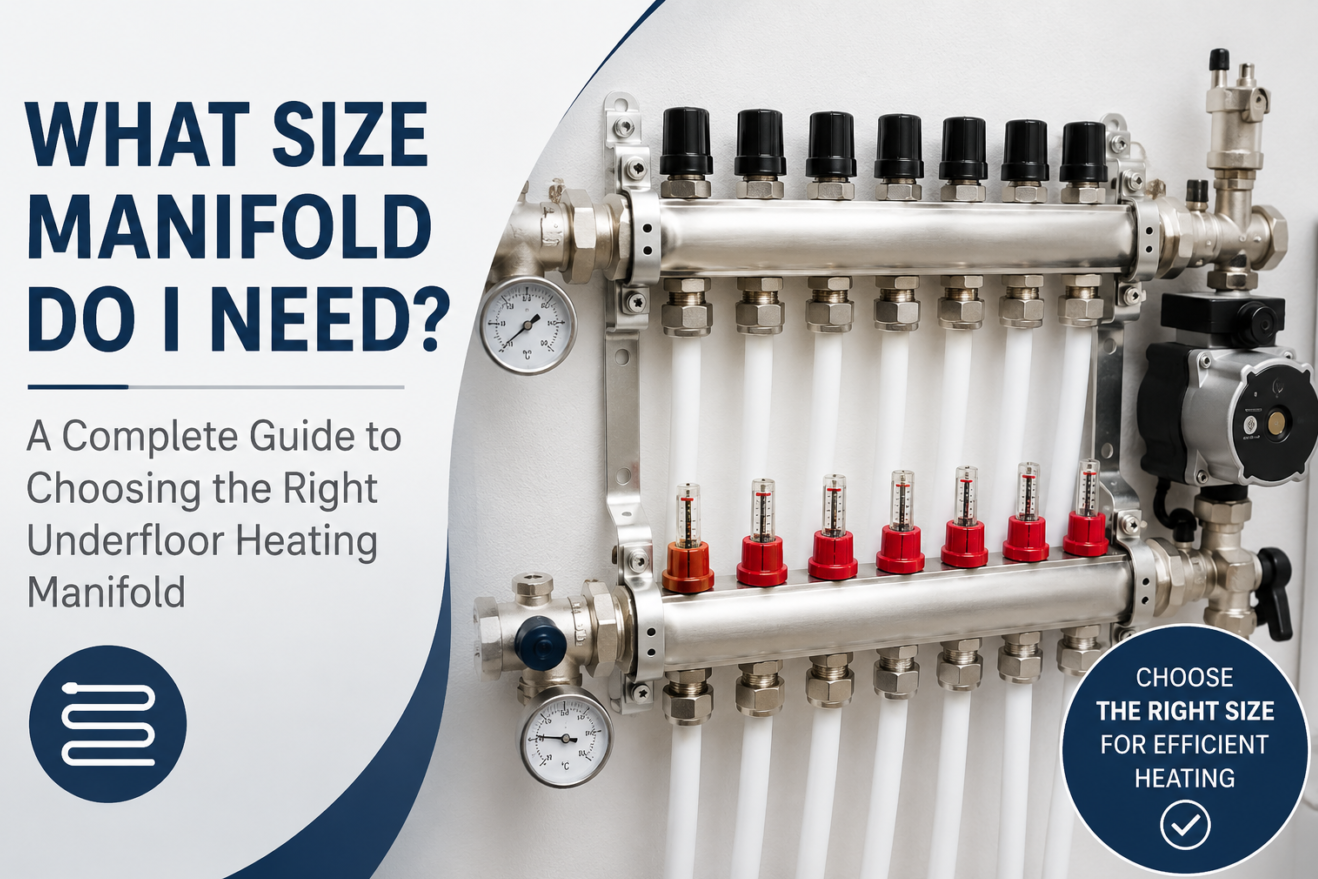
What Size Manifold Do I Need?
A Complete Guide to Choosing the Right Underfloor Heating Manifold
Choosing the correct underfloor heating manifold is one of the most important decisions when designing a water underfloor heating system. If the manifold is too small, you won’t have enough ports for all your heating circuits. If it’s unnecessarily large, you’ll pay more than needed and use valuable installation space.
In this guide, we’ll explain exactly how to choose the right manifold size, how many loops you need, and when you should consider installing multiple manifolds.
What is an Underfloor Heating Manifold?
The manifold is the heart of any water underfloor heating system. It distributes warm water from your boiler or heat pump into each heating circuit (loop) and returns the cooler water back to the heat source.
A quality manifold also allows you to:
- Balance water flow between loops
- Connect room thermostats and actuators
- Bleed air from the system
- Monitor pressure and temperature
- Isolate individual circuits for maintenance
Without the correct manifold size, your underfloor heating system cannot operate efficiently.
What Does “Port Size” Mean?
Many people think a larger manifold refers to pipe diameter.
It doesn’t.
When we talk about manifold size, we mean the number of ports (connections) available.
Each heating loop requires one manifold port.
Typical manifold sizes include:
- 2 Port
- 3 Port
- 4 Port
- 5 Port
- 6 Port
- 7 Port
- 8 Port
- 9 Port
- 10 Port
- 11 Port
- 12 Port
How Many Loops Do I Need?
This depends on several factors:
- Total floor area
- Pipe spacing
- Pipe diameter
- Heat loss calculations
- Maximum loop length
As a general rule:
- A 16mm pipe loop should not normally exceed 100 metres
- One loop often heats approximately 15–20m², depending on pipe spacing and heat demand.
For example:
| Heated Area | Typical Loops | Recommended Manifold |
|---|---|---|
| Bathroom (8m²) | 1 | 2 Port |
| Kitchen (18m²) | 1 | 2 Port |
| Living Room (35m²) | 2 | 2 or 3 Port |
| Ground Floor (60m²) | 4 | 4 Port |
| Ground Floor (90m²) | 6 | 6 Port |
| Whole House (150m²) | 8-10 | 8-10 Port |
These are examples only. Every property should be designed individually.
Why Loop Length Matters
Many people assume larger rooms simply need longer pipe loops.
This is incorrect.
If a loop becomes too long:
- Water temperature drops before completing the circuit
- Flow resistance increases
- Pump efficiency decreases
- Balancing becomes more difficult
- Heating becomes uneven
That’s why professional designs split larger rooms into two or more loops instead of creating one very long circuit.
Should Every Room Have Its Own Loop?
Not necessarily.
Smaller rooms may share a manifold with neighbouring areas.
However, larger rooms often require multiple loops, for example:
- Large open-plan kitchens
- Extensions
- Conservatories
- Commercial spaces
A 40m² kitchen may require two or even three loops depending on the design.
Should I Buy a Larger Manifold?
Sometimes, yes.
For example, if your design requires five loops, many installers choose a 6-port manifold rather than a 5-port model.
This provides:
- Room for future extensions
- Easier system modifications
- A spare port if another circuit is added later
Having one unused port rarely causes problems and offers greater flexibility.
When Do You Need Multiple Manifolds?
Most domestic properties use a single manifold.
However, larger homes may require two or more.
Examples include:
- Large detached houses
- Properties with multiple floors
- Commercial buildings
- Systems with more than 10–12 loops
Installing two centrally located manifolds often results in shorter pipe runs, improved balancing and better overall efficiency.
Where Should the Manifold Be Installed?
Ideally, the manifold should be located:
- As centrally as possible
- Close to the rooms it serves
- In an accessible location
- Away from bedrooms where possible (to reduce pump noise)
Common installation locations include:
- Utility rooms
- Under stairs
- Plant rooms
- Airing cupboards
- Garage walls
Always leave sufficient space around the manifold for maintenance and servicing.
Do Heat Pumps Change Manifold Size?
No.
Whether your system uses:
- Air Source Heat Pump
- Ground Source Heat Pump
- Gas Boiler
- Oil Boiler
…the manifold size is still determined by the number of heating loops, not the heat source.
The pump and mixing arrangement may differ depending on system temperatures, but the number of manifold ports remains based on the design.
Can I Work It Out Myself?
You can estimate the manifold size, but a proper design should always include:
- Heat loss calculations
- Pipe spacing
- Loop lengths
- Flow rate calculations
- Pump sizing
- Floor construction
This ensures every room receives the correct amount of heat and avoids expensive installation mistakes.
We Can Design It for You
At The Underfloor Heating Expert, we provide FREE CAD pipe layout drawings with our water underfloor heating systems.
Our design service includes:
- Correct manifold sizing
- Loop calculations
- Pipe layout drawings
- Materials list
- Expert technical advice
This removes the guesswork and ensures your system is correctly designed from the start.
Frequently Asked Questions
Can I leave one port unused?
Yes. Many installers intentionally choose a slightly larger manifold for future expansion.
Is a bigger manifold more efficient?
No. Efficiency depends on correct design and balancing, not on having additional unused ports.
Can one room have two loops?
Absolutely. Large rooms commonly require multiple loops to maintain even heat distribution.
What’s the largest domestic manifold?
Most standard domestic manifolds are available with up to 12 ports. Larger properties often use multiple manifolds instead.
Final Thoughts
Choosing the correct manifold isn’t about guessing based on house size—it’s about understanding how many heating loops your system requires. A properly sized manifold helps ensure balanced flow, efficient operation, and reliable heating throughout your home.
If you’re unsure which manifold is right for your project, we’re here to help. Our experienced team can provide a free system design and CAD layout, ensuring you receive the correct manifold, pipe layout, and components for a reliable and energy-efficient underfloor heating installation.
